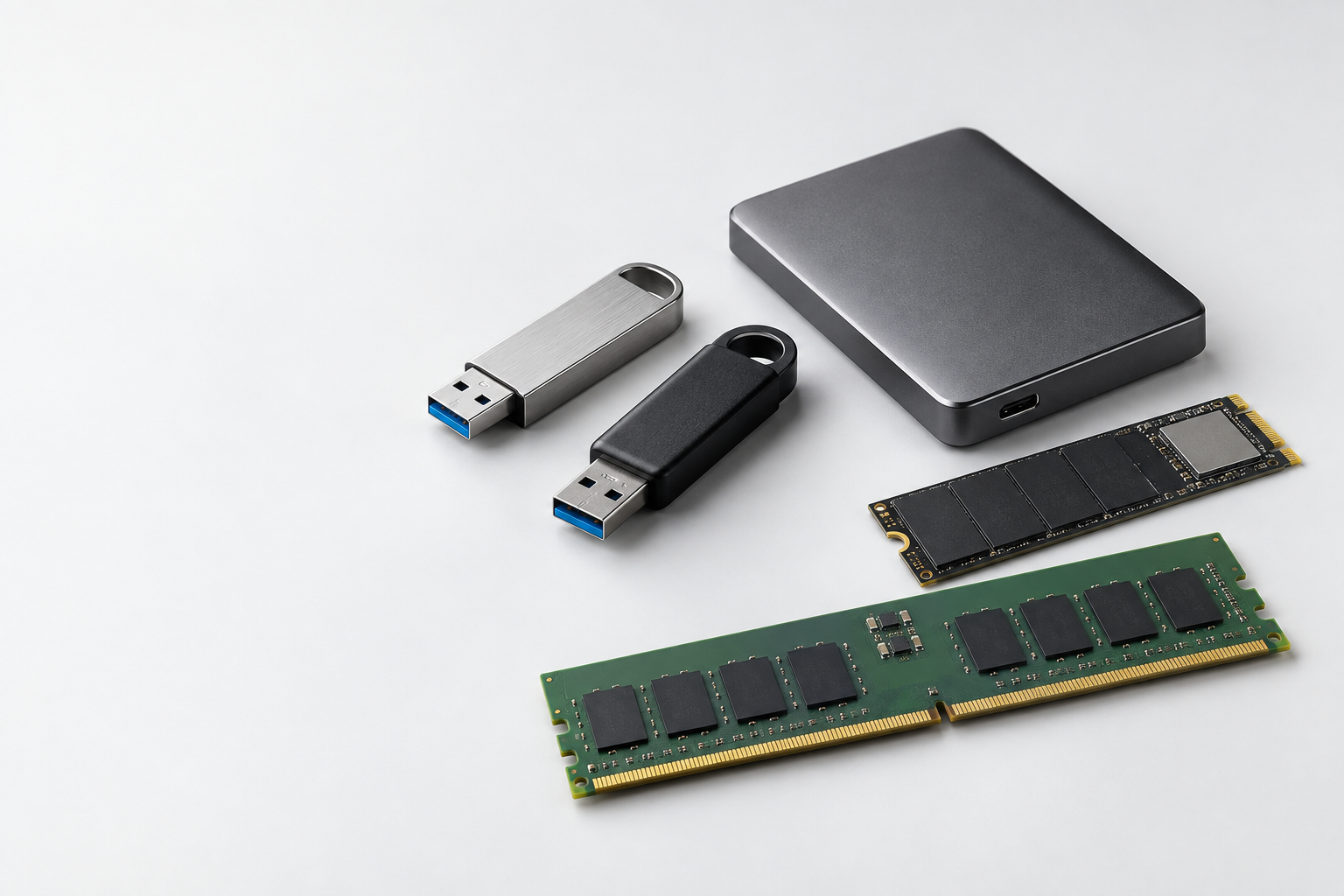
Quick answer: A custom external hard-drive program should be purchased as a controlled product-and-delivery project, not as a generic capacity quote. Select the drive around the end user’s backup or archive workload; then define interface, capacity, enclosure, branding, data preload, packaging, factory testing, and shipment inspection in one approved specification. This approach helps distributors and private-label brands compare portable hard-drive suppliers on evidence rather than headline price.
Introduction
External hard drives remain useful in B2B programs where large offline storage, straightforward USB access, and a familiar physical backup format matter. A distributor may need a dependable 1 TB or 2 TB product for a regional channel. A creative agency may supply project archives to clients. A corporate buyer may prepare a set of drives for local backups, data migration, training material, or field handover. In every case, the item carries more responsibility than a small promotional accessory: it holds information, must travel safely, and often represents the buyer’s brand at the moment it reaches the customer.
That is why an external hard drive wholesale request needs more detail than “2 TB, logo, 1,000 pieces.” The first question should be what the user will do with the drive. Will it receive periodic copies of office data? Will it carry a large video archive between locations? Is it a branded client gift with preloaded content? Does the intended computer fleet use USB-A, USB-C, or both? The answers change the appropriate configuration and the inspection plan.
This guide is written for importers, distributors, private-label brands, promotional-product agencies, and corporate procurement teams. It uses six target phrases naturally: external hard drive wholesale, portable hard drive supplier, custom external hard drive manufacturer, OEM external hard drive supplier, bulk external hard drives, and custom logo external hard drive. The goal is not keyword repetition; it is to answer the questions behind those searches in a way a buyer can use in an RFQ.
What a B2B External Hard Drive Program Includes
An external hard drive is usually a storage mechanism combined with an enclosure, controller or bridge board, USB connection, cable, packaging, and end-user documentation. For a branded program, there may also be a logo process, color standard, printed insert, label, barcode, data preload, and export carton requirement. Each element can affect the delivered customer experience.
The buyer does not need to become an engineer to source these products well. They do need a clear document that connects product use with verifiable details. A practical specification normally covers:
- The end-user application and expected files.
- Capacity and any usable-space requirement after a preload.
- USB connector and cable needs.
- Enclosure material, dimensions, finish, and drop-protection expectation.
- Logo method, artwork, color, packaging, and labeling.
- File-system format and data-preload rules, if relevant.
- Factory testing, functional sampling, and shipment-inspection criteria.
- Pilot quantity, bulk quantity, destination, and required arrival date.
When these details are missing, quotations can look comparable while describing different products. A quote that includes a basic generic box is not directly comparable with one that includes a printed retail sleeve, barcode, insert, preload verification, and export packing. The more accurately an RFQ describes the customer requirement, the more useful the supplier response becomes.
Choose the Right External Hard Drive Before You Customize It
Define the workload and the file pattern
Capacity is visible, but it is not the whole workload. Ask what kind of data users will keep on the drive: office documents, photos, large videos, engineering archives, periodic database exports, software installers, or a fixed library of preloaded material. Ask how frequently users will write to the device, whether they will use it on the move, and whether the data is a convenience copy or part of a formal backup process.
For example, a branded drive used to hand over a final media archive may need an approved folder structure, enough capacity headroom, and a presentation box. A drive used for regular field backup needs more attention to enclosure protection, cable handling, operating environment, and the recipient’s host devices. Neither application is “better”; they simply require different choices.
Confirm the computer ports before choosing the interface
USB-A still serves a large installed base of desktops and older notebooks. USB-C is increasingly common in new notebooks and mobile devices. Some programs benefit from a cable or adaptor strategy for mixed fleets. Connector shape does not by itself establish speed, compatibility, or charging behavior, so a buyer should map the actual target systems.
State the intended host devices in the RFQ. If a program is for a mixed Windows and Mac environment, say so. If drives will be used with a specific camera, point-of-sale terminal, or field workstation, name the model where possible. This turns vague compatibility language into a testable installation-preparation step.
Plan capacity as usable working space
A drive selected only because its printed capacity looks sufficient may become awkward after preload files, file-system overhead, future updates, or customer data are added. Decide how much space the buyer expects users to have after the final content is present. Confirm whether a full drive will be shipped, whether recipients must add files, and whether a particular file-system format is needed for cross-platform use.
Data storage is also not a substitute for a backup policy. A portable drive can support a backup workflow, but the organization should separately determine retention, encryption, access control, and recovery responsibility. The product supplier can help define a storage configuration; the customer remains responsible for the information-handling policy.
Custom External Hard Drive Manufacturer: What Can Be Customized?
The appropriate custom work depends on quantity, time, product family, and risk tolerance. A capable custom external hard drive manufacturer should explain which requests are part of a standard configuration and which require tooling, extended sampling, or a higher minimum order quantity.
Branding and surface finish
Common choices include a printed logo, laser marking where the enclosure material supports it, color selection, a label, or a printed insert. A sophisticated logo on a small surface needs a physical sample because line weight, contrast, and placement can look different from a screen proof. For color-sensitive brand programs, provide a defined reference and retain the approved sample as part of the production record.
Packaging and presentation
For distribution, packaging may need a product label, barcode, multilingual copy, compliance marks supplied by the buyer, inner-pack rules, carton labels, and retail-ready protection. For corporate gifting, a compact presentation box and insert may be more important than a retail hanging feature. Specify the recipient experience as well as the logistics need.
Data preload and folder structure
Preload is relevant for product catalogs, launch media, training kits, archived projects, and branded information packages. It should be managed as a separate deliverable. Define the final file source, version date, folder structure, file-system format, and verification method. A buyer should send virus-scanned, final files through an agreed controlled route. The supplier should not be asked to guess which version of a file is correct.
At sample approval, check that the exact files open on the intended systems. At shipment inspection, check a suitable sample against the approved file manifest. This creates an evidence trail for what was delivered without making unsupported claims about the customer’s later data use.
How to Compare a Portable Hard Drive Supplier
The best portable hard drive supplier for one project may not be the best choice for another. Instead of asking only for the lowest unit price, compare suppliers against the same product brief and score the strength of their evidence.
| Evaluation area | Questions to ask | Useful evidence |
|---|---|---|
| Requirement understanding | Can the supplier restate the application, interface, capacity, packaging, and delivery needs? | Written configuration recap |
| Sample control | Will the sample show the real logo, packaging, cable, and preload direction? | Artwork proof, sample plan, physical sample |
| Product fit | Are host devices, cable, file system, and capacity headroom discussed? | Compatibility notes and product specification |
| Custom work | Which details are standard and which require a new process? | Clear MOQ, timing, and approval milestones |
| Quality process | What factory testing is planned, and how are exceptions handled? | Agreed test scope and inspection checklist |
| Logistics | Are pack-out, carton labels, booking, and delivery milestones defined? | Timeline and packing specification |
Use the same comparison sheet for every candidate. A lower quote may still be a sound commercial decision, but it should not hide missing preload verification, unapproved packaging, vague connector assumptions, or an unrealistic delivery schedule.
Mid-article CTA — Need a sample-ready external-storage brief? Send StorFlux your capacity range, user devices, logo artwork, packaging direction, preload requirement, quantity, and destination. We will help you turn the request into an RFQ that suppliers can quote consistently. Send Your Requirements.
Factory Testing and Shipment Inspection for Bulk External Hard Drives
Testing should reflect the agreed configuration and the commercial risk. It is not useful to publish a generic “100% tested” statement without stating what is tested, how exceptions are handled, and what the buyer can inspect. A project might require a combination of visual checks, functional detection, capacity verification, representative file-access checks, cable and connector checks, preload confirmation, label checks, and packaging inspection.
Define the reference standard before production
The approved physical sample, final artwork, product specification, packaging layout, content manifest, and PO should form one reference set. If a revision is made after sample approval, document it in writing. This avoids the common issue where sales, factory, inspector, and buyer are all looking at different versions of a requirement.
Separate product checks from pack-out checks
Product checks relate to the drive body, finish, logo, connector, cable, and agreed functional behavior. Pack-out checks relate to the insert, box, barcode, inner cartons, master cartons, quantity, shipping marks, and protection. Both matter. A technically working drive can still fail a retail or event program if its packaging is incomplete or incorrectly labeled.
Use representative file checks for preload projects
If a drive ships with content, capacity alone is not sufficient. Inspect an agreed number of units for file accessibility, correct folders, file version, and cross-platform opening where the brief requires it. Record the result against the approved manifest. This is especially important when the customer delivers last-minute marketing assets or localized language packs.
Plan the inspection timing
An OEM external hard drive supplier should know in advance whether the buyer will use an internal review, third-party inspection, photo report, or other agreed release process. Define when the inspection happens relative to final packing, payment, and dispatch. Late requests can cause avoidable shipping changes; early alignment makes the schedule more reliable.
For an overview of how StorFlux frames product checks, read our quality process. For factory context, visit our Shenzhen facility.
Common External Hard Drive Sourcing Mistakes
Quoting a capacity without describing the application
“2 TB external drive” is not a complete purchasing specification. It does not say what host devices are used, whether files are preloaded, how the product travels, what packaging it needs, or what must be tested. Begin with a one-sentence use case and expand from there.
Treating USB-C as a complete compatibility answer
The port shape alone does not replace a device matrix. Ask whether the target systems, supplied cable, file system, and expected transfer task have been considered. A quick pilot with representative hardware prevents broad assumptions.
Approving branding from a digital proof alone
A file proof helps, but it cannot fully show logo contrast, enclosure texture, alignment, cable feel, box assembly, or recipient perception. Use a physical sample for a new custom logo external hard-drive program.
Delaying preload decisions until the final production week
Preload needs final files, an agreed format, a verification step, and sometimes customer approvals. Build it into the timeline from the beginning. If files are not final, state that explicitly and protect time for the final approval.
Making shipment inspection an afterthought
Inspection works best when the criteria are part of the order. Decide what will be checked, what reference will be used, how findings are reported, and how corrections are approved before volume production begins.
FAQ
What should I include in an external hard drive wholesale RFQ?
Include the end-use case, desired capacity, estimated quantity, target host devices, connector and cable preference, branding, packaging, preload, destination, arrival date, and inspection expectation. A supplier can quote more accurately when the request explains the user workflow rather than only a capacity.
Can bulk external hard drives be delivered with preloaded files?
Yes, but preload should be specified and verified separately. Agree the final content source, folder structure, file-system format, version control, and an inspection method. Approve a sample with the intended content before mass production when the files are important to the program.
How do I choose a portable hard drive supplier for a private-label project?
Compare suppliers on how clearly they document the configuration, sample process, product compatibility, branding method, packaging, test scope, timeline, and change control. The best proposal is not necessarily the lowest quoted unit price; it is the one that gives the buyer an inspection-ready, repeatable product definition.
What should be checked before shipping custom external hard drives?
Check the approved model and capacity, product appearance, logo and labels, connector and cable, functional sampling, any preload content, inner pack, cartons, quantity, barcode, and shipping marks. Set the exact sampling and acceptance approach before production.
Are external hard drives suitable for corporate gifts?
They can be suitable when the recipient benefits from usable offline storage and the packaging supports the brand message. Confirm capacity, interface, logo method, presentation box, and whether the drive will include useful approved content. For lighter distribution needs, compare them with a USB flash drive or portable SSD.
Conclusion
An external hard-drive program is successful when the product, brand experience, data handling, and release process support the same customer use case. Start with the workload and host devices. Then define capacity, interface, enclosure, logo, packaging, preload, factory testing, and shipment inspection in one controlled specification. That is a stronger foundation than chasing a price list alone.
StorFlux helps B2B buyers turn an early product idea into a sample-ready configuration for global distribution. We can discuss standard portable-storage options, branding, packaging, data preload, and a realistic inspection path before a bulk order is released.
Final CTA — Build an external-storage program with a clear approval path. Tell StorFlux about your product application, capacity, quantity, artwork, packaging, and destination. We will help you prepare a configuration and quote discussion. Get a Quote or explore OEM & ODM services.
Sources and related StorFlux pages
Discuss your storage requirement
Send StorFlux the intended use, capacity, platform or device list, branding direction, quantity, and delivery target. We will help you convert it into a sample-ready B2B brief.
Get a Quote