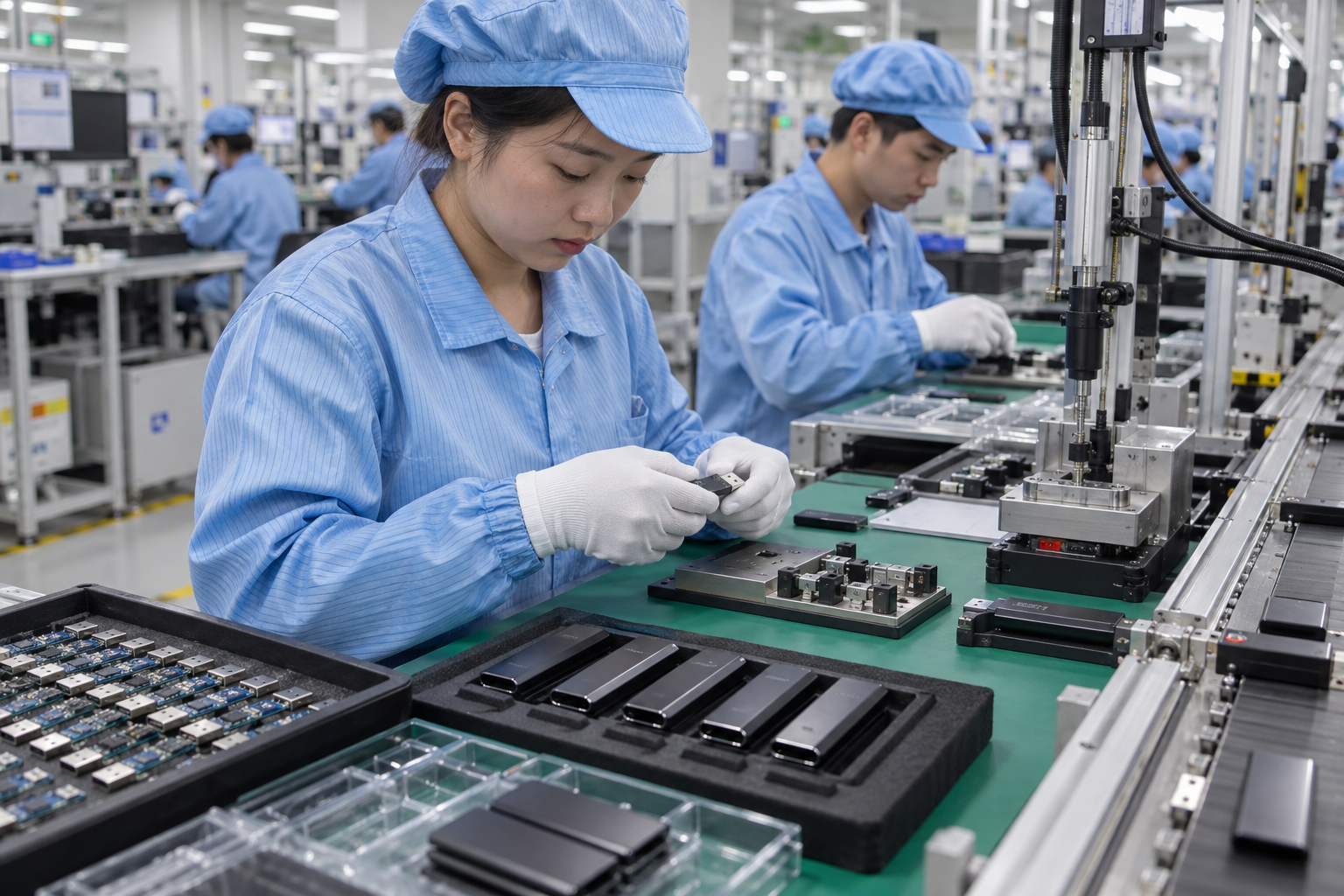
Quick answer: A DDR5 RAM wholesale order should begin with the exact platform and module type, then match capacity, speed class, DIMM format, operating requirements, labeling, qualification, and inspection to that platform. Desktop UDIMM, laptop SO-DIMM, and server-class memory are not interchangeable. A dependable memory module supplier helps document the proposed configuration and sample path, while the buyer validates final compatibility in the target motherboard or system.
Introduction
DDR5 is an important category for PC builders, distributors, IT integrators, and private-label component programs. It is also easy to buy incorrectly when a request stops at “32 GB DDR5.” That line does not identify whether the target is a desktop, a laptop, a workstation, or a server. It does not identify the supported module type, capacity per slot, target memory configuration, BIOS/UEFI environment, or the validation process that should be completed before a bulk purchase.
Memory is a platform component. A module’s generation, physical format, capacity, rank and configuration, error-correction requirement, and supported operating profile must fit the exact computer or motherboard. That is why a high-quality B2B enquiry gives an OEM RAM supplier more than a capacity and price target: it gives the system list, the intended role, and the required evidence before the product enters a build or channel program.
This article targets six phrases without turning them into filler: ddr5 ram wholesale, memory module supplier, bulk ram memory, oem ram supplier, ddr5 udimm wholesale, and ddr5 sodimm wholesale. It is written for overseas buyers sourcing systems or product lines, not for an individual overclocking tutorial. The focus is controlled selection, customer requirements, installation preparation, factory testing, and shipment inspection.
The First Rule: Match RAM to the Platform
DDR5 is not a replacement module for a DDR4 system
DDR4 and DDR5 are different memory generations with different platform requirements. A buyer should not assume an upgrade is possible by changing only the module. Confirm the system’s motherboard or laptop documentation, processor support, slot type, supported memory generation, maximum capacity, and any vendor qualification information before specifying a module.
This is an important practical point for distributors. A channel may sell DDR4 and DDR5 product lines at the same time because the installed hardware base is mixed. The right selection is the one compatible with the customer’s platform and use case, not the newest-sounding generation in isolation.
Identify the physical module type
Desktop and many workstation systems commonly use UDIMM modules. Laptops and compact machines commonly use SO-DIMM modules. Server platforms can require specific module classes and error-correction features based on the system architecture. These physical and electrical formats must not be mixed in an RFQ.
For a DDR5 UDIMM wholesale project, ask which desktop or workstation boards are being supported and how many slots will be populated. For a DDR5 SO-DIMM wholesale project, identify laptop, mini-PC, or embedded-system models and check service access and maximum supported capacity. For server requirements, do not substitute a consumer module for a part specified by the platform; confirm the required memory class directly from the server or motherboard documentation.
Build a simple compatibility matrix
Create a table with one row per system family. Record model and board revision, processor, memory generation, physical slot type, maximum system capacity, slot count, target module capacity, intended population pattern, operating-system image, and validation status. Add BIOS/UEFI version when it is relevant to the deployment.
This matrix turns a broad bulk RAM memory enquiry into a controlled order. It also helps a buyer separate an approved configuration from a similar-looking module that may not be suitable for every system in the fleet.
How to Define DDR5 Capacity for a B2B Program
Capacity should follow the application, not a generic “best size” statement. Consider the operating system, business applications, browser and collaboration workload, virtual-machine use, file size, content-creation tools, and future refresh cycle. For a system integrator, the goal is to set a repeatable bill of materials that gives users appropriate headroom without making the product range unnecessarily complex.
Office PCs and general business deployments
Start with the application stack and procurement policy. A browser-heavy workflow, large spreadsheets, multiple collaboration tools, or local data analysis may need a different memory target than a light terminal or signage system. Document the use profile and test the intended image with typical concurrent applications.
Workstations and creative systems
Graphics, design, engineering, media, and data-oriented workstations can require higher capacity based on the active project files and software. The right method is to test a representative workload and monitor whether the system has enough operational headroom. Do not use a generic consumer recommendation in place of customer-specific validation.
Laptops, mini PCs, and embedded systems
Compact systems add a mechanical and serviceability consideration. Check whether memory is replaceable, which SO-DIMM configuration is supported, and how access is handled in the actual chassis. For a field deployment, it can be more valuable to standardize an approved configuration than to pursue many small variations.
Server and specialized infrastructure
Server memory selection is platform-defined. Capacity is only one field. The buyer must confirm the required module class, any error-correction need, processor memory rules, and the system vendor’s documented guidance. If the application is virtualized or memory-intensive, the system architecture and workload analysis should lead the requirement.
What to Ask a Memory Module Supplier
A capable memory module supplier should be comfortable working from a structured RFQ. The following questions help separate a useful B2B response from a generic product listing.
| Question | Why it matters | Evidence or action |
|---|---|---|
| Which module type fits our platform? | Prevents UDIMM, SO-DIMM, or server-class mismatches | Platform list and proposed module description |
| What capacity and configuration are recommended? | Aligns modules with actual user workloads | Capacity plan and pilot systems |
| What speed class and operating conditions are assumed? | Avoids unqualified compatibility claims | Exact platform and validation setup |
| Can we receive a qualification sample? | Gives the buyer evidence before scale | Sample or pilot order and documented test steps |
| How are labels and packaging controlled? | Supports channel, integration, and traceability needs | Artwork, label proof, pack-out specification |
| How are changes communicated? | Protects repeat builds and private-label programs | Written change-control process |
| What factory testing and inspection points apply? | Makes quality language meaningful | Agreed test and shipment-release plan |
The supplier should not make unsupported promises about every motherboard in the market. Instead, it should help the buyer specify the intended platforms clearly enough to test. The final responsibility for qualifying a particular module in a particular finished system belongs with the system builder or project owner.
DDR5 UDIMM Wholesale vs DDR5 SO-DIMM Wholesale
UDIMM for desktop and workstation builds
UDIMM projects commonly involve desktop PCs, workstations, industrial PCs, and certain compact systems. The sourcing checklist should cover the board model, slot count, target memory layout, chassis access, processor, BIOS/UEFI, image, and use case. A two-module configuration and a single-module configuration may create different capacity and channel-planning implications, so state the intended population pattern.
SO-DIMM for notebooks and compact systems
SO-DIMM sourcing is often connected to laptop upgrade programs, mini PCs, embedded computers, education deployments, and field-service systems. Installation preparation matters: make sure the memory is serviceable, that the correct slot type is documented, and that the technician workflow has been tested. For an OEM program, packaging and label clarity can reduce errors at the integration line.
Do not use one format as a substitute for another
The choice is governed by the system’s physical socket and documented support. A high-capacity module that does not fit the device is not a useful alternative. Keep the actual form factor in the product title, label, purchase order, and carton mark so receiving teams can distinguish similar shipments quickly.
Mid-article CTA — Need a RAM RFQ built around your system list? Send StorFlux the computer or motherboard models, module type, capacity target, forecast, target market, and packaging requirement. We will help you organize a sample-ready DDR4 or DDR5 memory brief. Send Your Requirements.
OEM RAM Supplier and Private-Label Considerations
An OEM RAM supplier relationship is most effective when the product’s technical and commercial identity are controlled together. A distributor may need private-label packs. A PC builder may need modules delivered in integration-friendly packaging. A brand may need labels, barcodes, color direction, inserts, and a consistent product naming convention.
Product label and customer clarity
The label should accurately identify the generation, capacity, module type, and other agreed product information. Avoid using a generic label design that could make a DDR4, DDR5, UDIMM, or SO-DIMM item difficult to distinguish in a warehouse. A clear label supports receiving, assembly, support, and customer confidence.
Packaging for integration or retail
Bulk anti-static packaging may suit an internal assembly program. Individual retail packaging may suit a distributor or private-label channel. The right option depends on how the module will be handled, protected, counted, and presented. Define inner-pack quantity, protection, barcode, inserts, master cartons, and shipping marks before production or packing begins.
Traceability and change control
Decide whether the project needs serial numbers, batch references, or other traceability fields. More importantly, define how an OEM RAM supplier will communicate a configuration change that could require revalidation. The buyer need not demand impossible component immutability; the buyer does need a transparent path for reviewing changes that materially affect the approved program.
Factory Testing, Integration Testing, and Shipment Inspection
Factory testing should have a defined scope
When a supplier says a memory module is tested, ask what that means in the context of the order. The appropriate method may include agreed functional checks, visual inspection, label verification, packaging inspection, and handling of exceptions. The test method, sample approach, and records should be discussed with the supplier before production or dispatch.
Do not overstate what a factory result proves. A component-level test does not prove the module will operate in every possible board, BIOS/UEFI version, or application. It is one layer of evidence in a broader quality process.
System-level validation is the buyer’s qualification step
Install the sample in representative target systems. Check recognition, boot, operating-system image behavior, the intended applications, and the physical installation process. If the project will be repeated across sites or technicians, document the steps in a work instruction. This is where installation preparation becomes a measurable process rather than a verbal assumption.
Shipment inspection verifies the approved item
Before dispatch, inspect the correct product type, capacity, labels, quantities, packaging, accessories if applicable, carton marks, and agreed functional samples. For a branded program, compare the shipment to the approved label and pack-out reference. For an integration project, confirm that the modules delivered match the specified build list.
StorFlux can help frame a quality discussion around your project through our quality page. The most useful acceptance plan is one written before an order is ready to ship.
Common Mistakes in Bulk RAM Memory Procurement
Ordering by generation and capacity only
“DDR5 32 GB” does not identify UDIMM versus SO-DIMM, platform compatibility, module population, speed expectation, or use case. Include the system and module type in the RFQ.
Mixing DDR4 and DDR5 requirements
Different system generations require different platform support. Keep each product family and each system list clear. When a channel serves mixed hardware, separate the pages, labels, SKUs, and internal receiving rules.
Treating speed as a universal promise
The actual system platform, BIOS/UEFI, memory configuration, and workload determine whether a proposed setting is appropriate. Describe what is supported by the target environment rather than publishing an unqualified claim.
Skipping a sample in a new system family
A sample or pilot is a practical way to verify system recognition, assembly, image deployment, and label/packaging requirements. It is especially valuable when a project has multiple board revisions or a private-label pack-out.
Leaving packaging decisions to the end
Memory modules need appropriate handling and protection. Packaging also affects barcode scanning, warehouse receiving, integration flow, and retail presentation. Approve it alongside the product, not after the technical decision is complete.
FAQ
What should I send to a DDR5 RAM wholesale supplier for a quotation?
Send the target system or motherboard list, required module type, desired capacity, expected configuration, quantity, use case, destination, packaging, label requirement, sample expectation, and delivery target. The more clearly the platform is described, the more useful the supplier’s response will be.
What is the difference between DDR5 UDIMM and DDR5 SO-DIMM wholesale?
UDIMM is typically used for desktop and many workstation-style systems, while SO-DIMM is commonly used in laptops and compact devices. They are different physical module formats and must be matched to the exact system socket and documentation. Do not use one as a substitute for the other.
Can DDR5 RAM be installed in a DDR4 motherboard?
No. Memory generation must match platform support. Confirm the motherboard or system documentation before selecting modules. A DDR4 system should be sourced with DDR4-compatible memory, and a DDR5 system with DDR5-compatible memory.
How should an OEM RAM supplier support a private-label program?
The supplier should help define the module type, capacity, label information, packaging, barcodes, sample path, quality checks, delivery schedule, and change-control method. The buyer should perform final platform qualification in the intended system.
What should be inspected before a bulk RAM shipment is released?
Check the correct generation, module type, capacity, labels, quantities, packaging, protective materials, carton marks, and agreed functional sampling. Compare against the approved specification and pack-out reference before dispatch.
Conclusion
Successful DDR5 RAM wholesale sourcing is built on platform clarity. Identify the system, module format, capacity, configuration, application, and deployment process before comparing offers. Then validate a representative sample, document the approved product and packaging, and agree factory testing and shipment inspection early in the project.
StorFlux supports B2B memory-module discussions for distributors, PC builders, and integration programs. We can help you translate a platform list and channel requirement into an orderly RAM sourcing brief for DDR4 or DDR5 modules.
Final CTA — Source memory modules with the right platform controls. Send StorFlux your target systems, UDIMM or SO-DIMM requirement, capacity, quantity, labels, packaging, and delivery plan. Get a Quote or explore StorFlux products.
Sources and related StorFlux pages
Discuss your storage requirement
Send StorFlux the intended use, capacity, platform or device list, branding direction, quantity, and delivery target. We will help you convert it into a sample-ready B2B brief.
Get a Quote